
Description
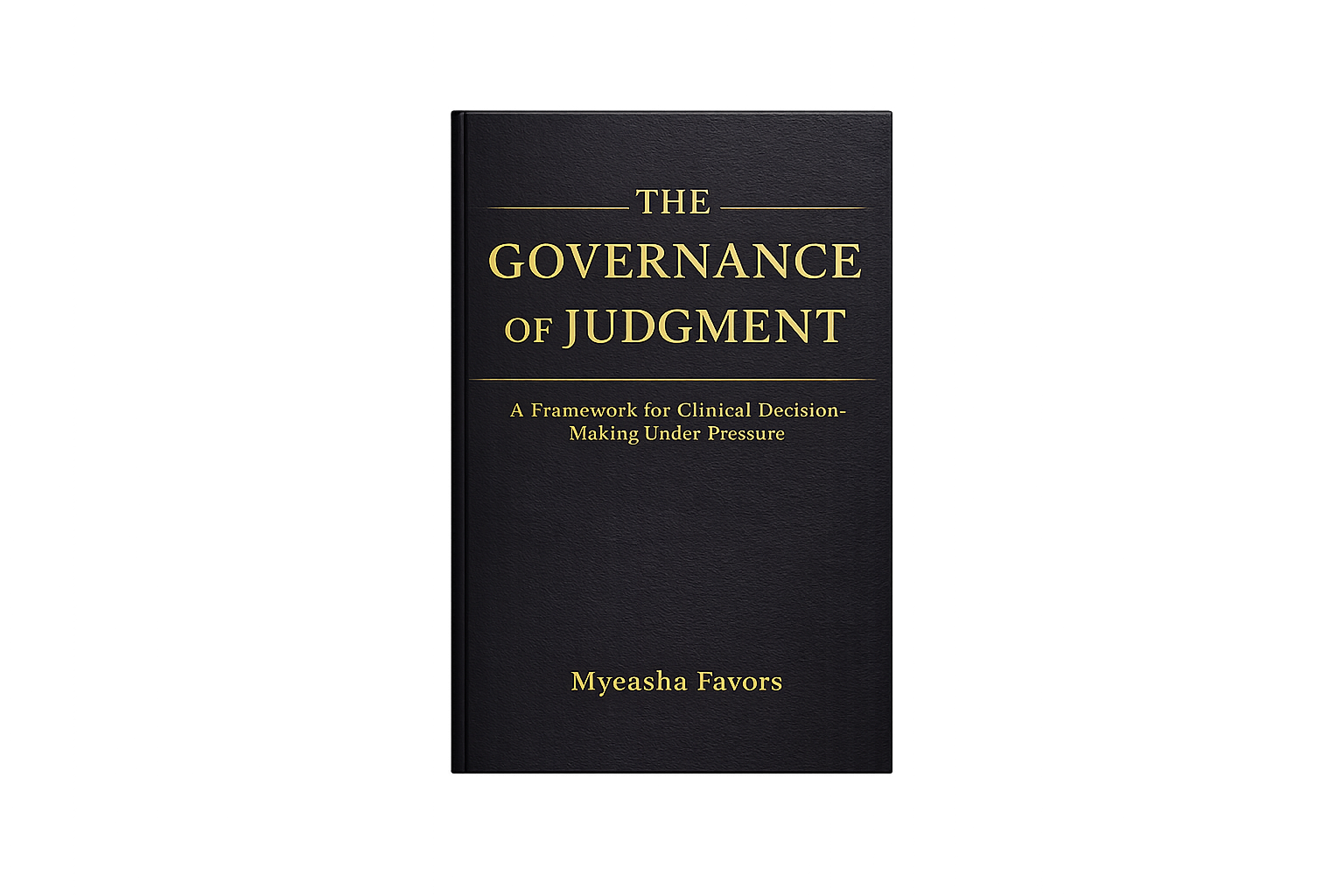
The Governance of Judgment challenges a deeply embedded assumption in healthcare and other high-pressure systems: that performance failure is primarily an individual problem.
When decisions made under pressure lead to adverse outcomes, institutions respond predictably. They investigate the individual, mandate training, and document remediation. This response is comforting, measurable, and wrong.
This book establishes that judgment quality is determined not by individual competence alone, but by the conditions under which decisions are made. Time compression, cognitive load, information ambiguity, authority constraints, resource availability, and margin for error are system-produced variables. When those variables are ungoverned, failure is inevitable. No amount of training can compensate.
Introducing I.F.O.R.M.™—Information, Focus, Options, Readiness, and Margin—this work reframes decision-making under pressure as a governance responsibility rather than a behavioral deficit. I.F.O.R.M.™ is presented not as a checklist or training tool, but as a leadership standard for governing decision conditions before failure occurs.
Written for executives, clinicians, risk leaders, regulators, and institutional decision-makers, The Governance of Judgment provides a rigorous, system-level diagnosis of why competent professionals fail predictably under pressure—and why leadership accountability for decision conditions is the only durable solution.
This is not a book about improving people.
It is a book about governing systems.
Reviews
There are no reviews yet.